Anthropic's S-1 says $11.6 billion in one quarter and an $80.7 billion loss. Both are true. Here's how to read it.
Originally published on LinkedIn.
This morning Anthropic filed to go public. Ticker ANT, Nasdaq, Goldman Sachs and Morgan Stanley on the cover. The share count and the price are still blank.
The filing itself runs hundreds of pages. I spent the day in the financial sections, because the two numbers everyone is posting ($11.6 billion of revenue in a quarter, an $80.7 billion loss in a half) sound like they can't both be true. They are. Here's what's behind each one, what the compute bill really looks like, and the part of the filing I think matters most if you sell anything for a living.
I run my back office on AI agents, and Anthropic's models are part of that stack, so I'm not a neutral reader. Every number below is from the S-1, and I've linked it so you can check me.
The revenue number
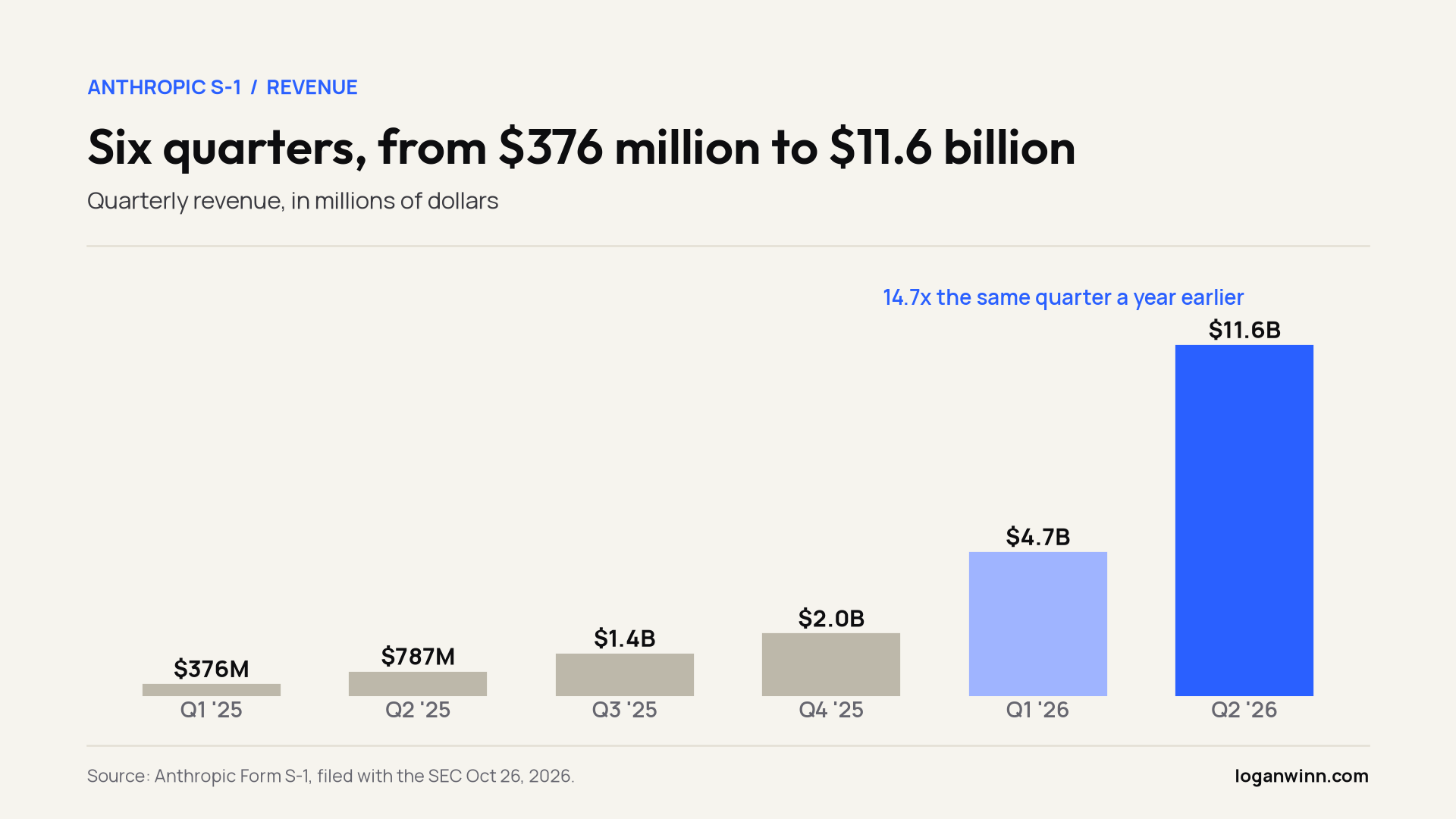
Annual revenue went $41 million in 2023, $386 million in 2024, $4.6 billion in 2025. Then the first half of 2026 alone was $16.3 billion, against $1.2 billion in the first half of 2025.
The quarter that matters is April through June 2026: $11.6 billion, up from $787 million in the same quarter a year earlier. That's 14.7 times.
One detail from the revenue note that I'd underline if you sell software. 80% of that revenue is consumption-based (metered usage), and 20% is subscriptions like Pro and Max. Metered revenue grows when the customer's usage grows, with no renewal meeting required. It's also the reason the filing says plainly that its growth rate is expected to decline over time: usage can go down as fast as it went up.
The loss number
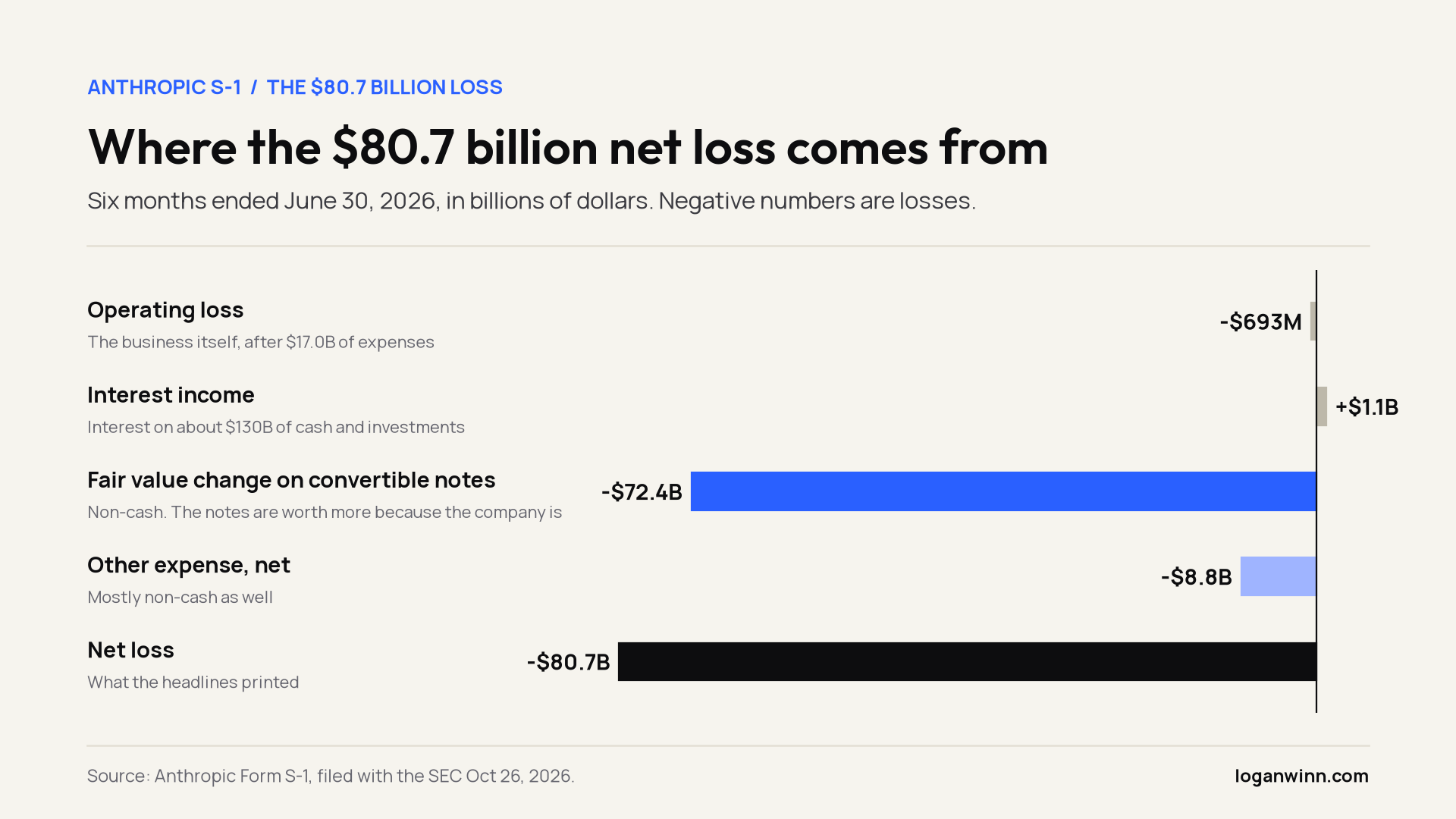
The $80.7 billion net loss is real on the income statement. Here's what's inside it.
- Operating loss, which is the business itself: $693 million for the half.
- Change in fair value of convertible notes and similar instruments: $72.4 billion. Anthropic raised a lot of money through notes that convert into stock at a value tied to the company. When the valuation jumped, the accounting value of those notes jumped with it. The filing says this is the main driver, and it's non-cash. No money left the building.
- Other expense: $8.8 billion, also mostly non-cash charges.
- Interest income: $1.1 billion, earned on roughly $132 billion of cash and short-term investments.
So the half-year "loss" from running the company was $693 million on $16.3 billion of revenue. And the second quarter flipped positive.
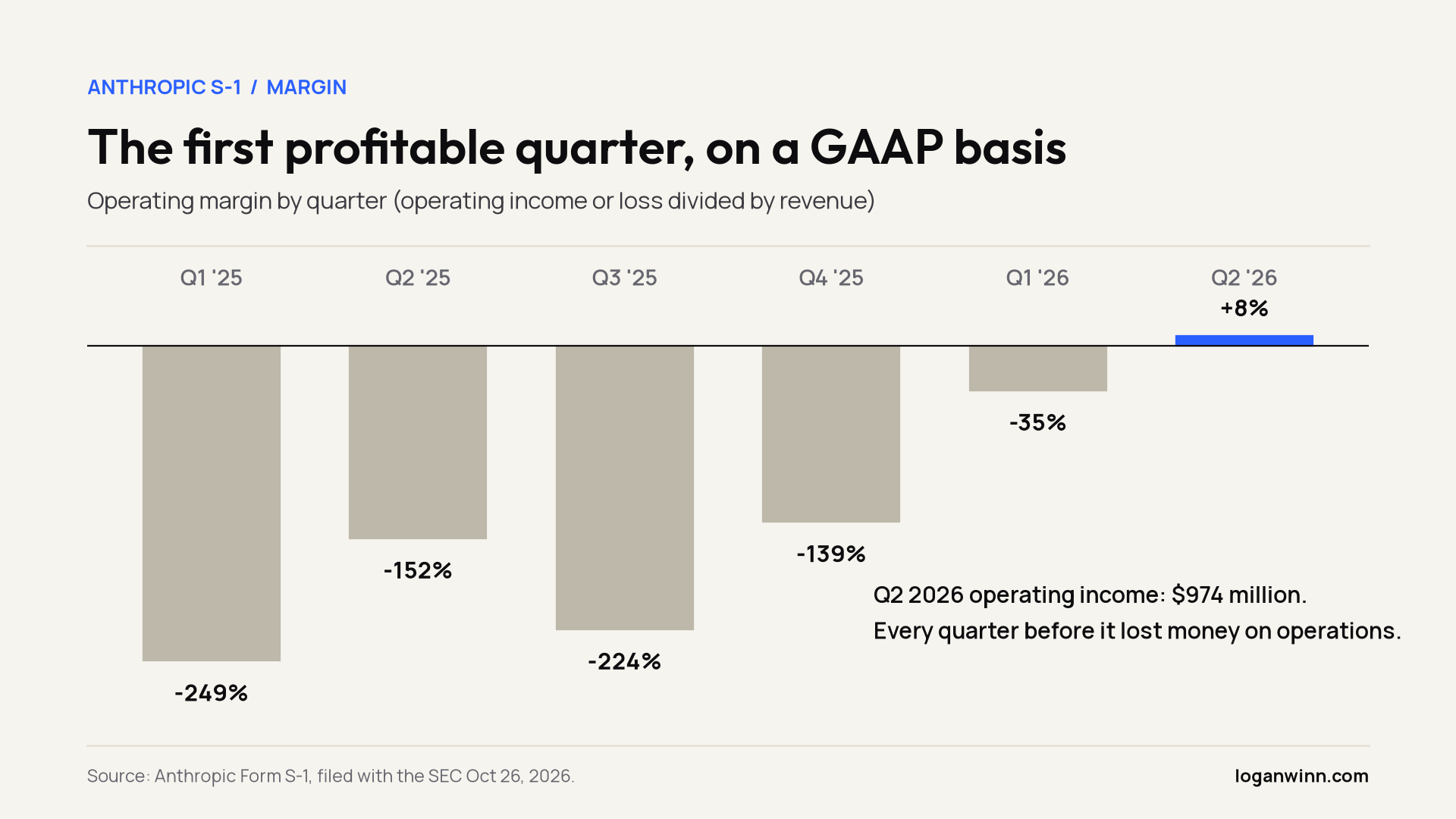
Q2 2026 operating income was $974 million, an 8% operating margin. The quarter before that was a 35% loss margin, and Q1 2025 was a 249% loss margin, meaning expenses were three and a half times revenue. On the filing's adjusted basis (which strips out stock compensation), Q2 was 19%.
I don't know whether 8% holds in Q3. The filing leaves Q3 revenue blank. But the direction of that chart is the whole bull case in one picture.
The compute bill is the real story
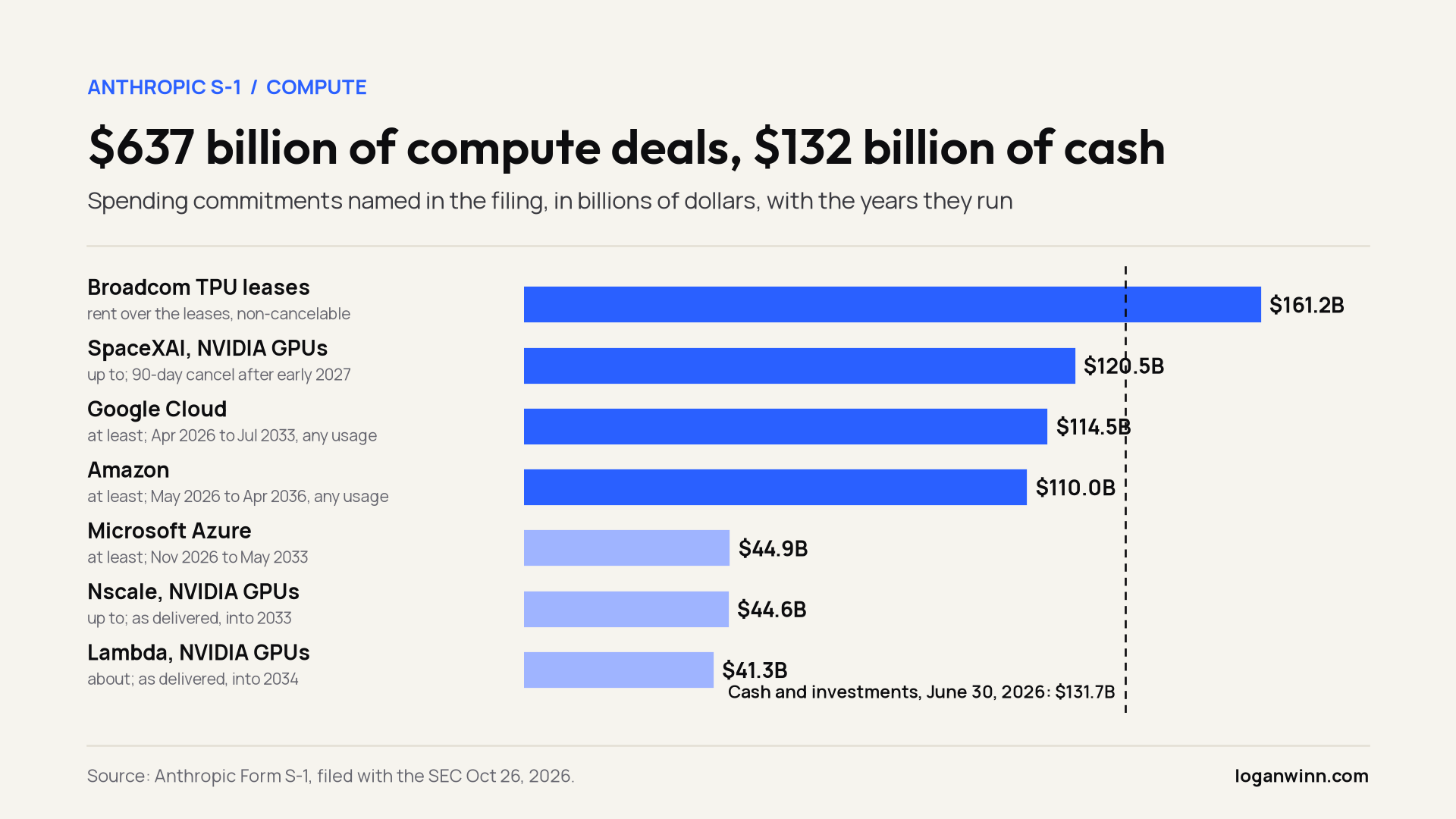
Add up the compute deals the filing names and you get about $637 billion.
- Broadcom TPU leases: about $161.2 billion of rent over the leases, non-cancelable.
- SpaceXAI (NVIDIA GPUs): up to $120.5 billion into 2029, cancelable on 90 days' notice after the initial periods end in early 2027.
- Google Cloud: at least $114.5 billion from April 2026 to July 2033.
- Amazon: at least $110.0 billion from May 2026 to April 2036.
- Microsoft Azure: at least $44.9 billion from November 2026 to May 2033.
- Nscale and Lambda (NVIDIA GPUs): about $44.6 billion and $41.3 billion, accruing as capacity is delivered.
The Google and Amazon minimums are owed, in the filing's words, "regardless of actual usage." If Anthropic spends less, it pays the difference as a true-up.
Against that: $131.7 billion of cash and investments at June 30, and $141.1 billion raised in total since founding. Compute and infrastructure expense was $8.9 billion in the first half, so the commitments are many years of today's spend.
This is where the risk lives, and the filing says so. The bet is simple to state. If demand keeps growing, locking capacity years ahead at negotiated prices was the cheap way to do it. If demand flattens, the minimums come due anyway.
The customers, which is the part I care about
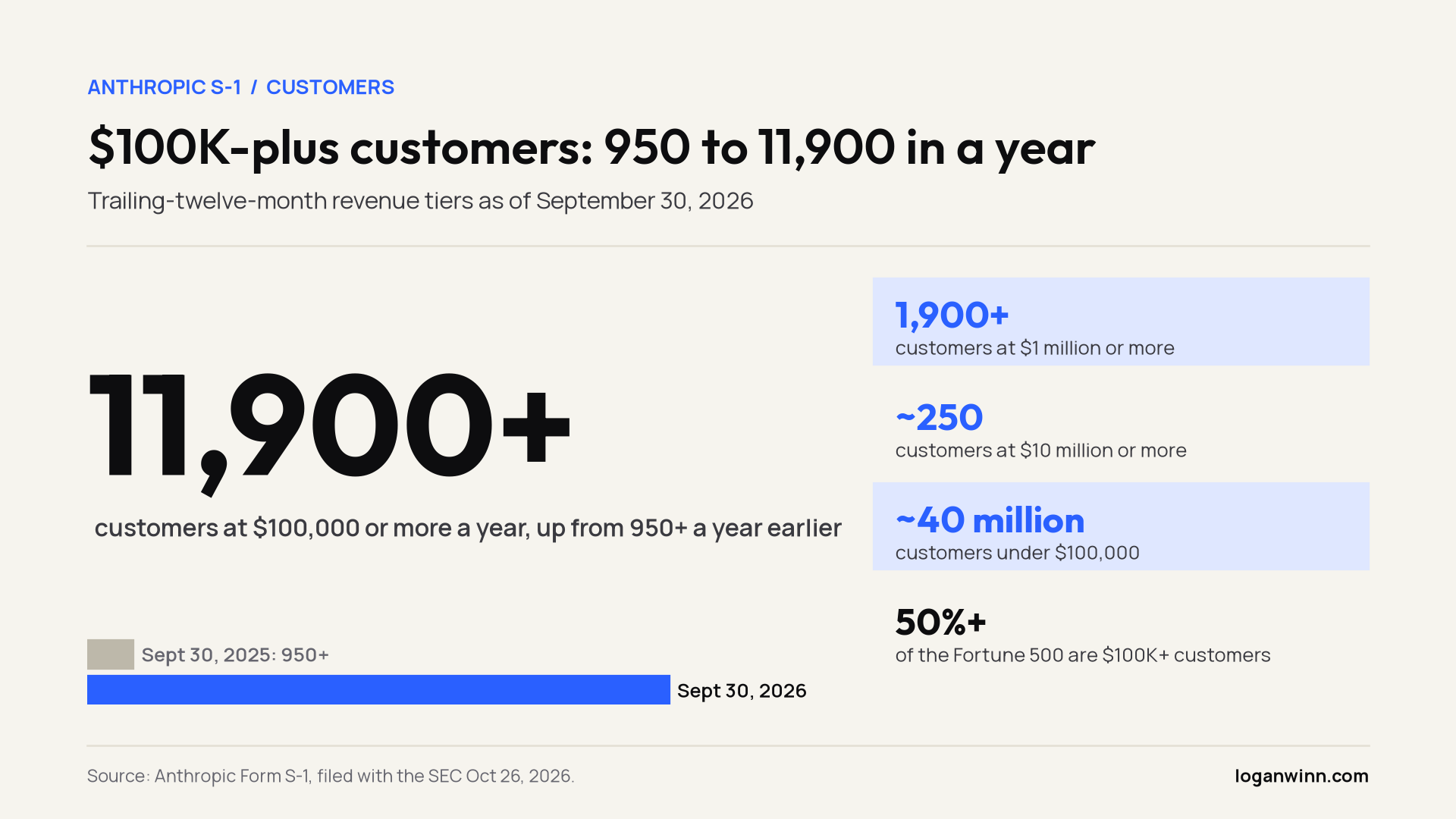
I spent seven years in sales, and this is the section I'd hand to any revenue leader.
Customers spending $100,000 or more a year: more than 11,900, up from more than 950 a year earlier. More than 1,900 spend $1 million or more. About 250 spend $10 million or more. Over half the Fortune 500 is in the $100,000 tier. Another 40 million customers spend under $100,000 each.
And yet the filing says revenue from those Fortune 500 customers is, on average, less than 0.1% of their total expenses. Even the top ten are under 1%. That's the expansion pitch in one line.
Two things an operator should take from this.
First, concentration. The top five customers were about 25% of revenue for the nine months to September 30, with no single one over 10%. Many of the biggest customers aren't on long-term contracts. The filing lists this as a risk, and it is.
Second, the channel. 48% of first-half revenue came through the cloud marketplaces (AWS, Google Cloud, Azure), up from 11% in 2023. Sales, marketing and partnerships expense went from $120 million to $3.2 billion in a year, and the filing ties much of that to partner costs. Read that as: the buyer's committed cloud budget is now the purchasing department. If you sell software and you're not listed where that budget already sits, you're asking your customer to run procurement twice.
The efficiency line is the one I keep coming back to. Headcount went from about 940 at the end of 2024 to about 5,300 in September 2026. Revenue per employee went from $1.4 million to $6.6 million in a year. That's what a company that uses its own product on itself looks like.
Two things that won't make the headlines
The founders keep control. A special Class F share held by the seven co-founders carries 50.1% of the vote on most matters, and a Long-Term Benefit Trust elects some of the directors. If you buy ANT, you're buying the economics, not the steering wheel.
The risk factors say what the company has always said in public. The filing states that sufficiently advanced AI, built without the right safeguards, could pose "catastrophic or existential risks to humanity." I can't think of another company telling the SEC its product could be that dangerous while asking you to buy shares. Whether that reads as honesty or as a warning is up to the buyer.
What I'm watching
The run-rate number and the price range are blank. Reports put the target in the $1.5 trillion to $2 trillion range (the Yahoo Finance live blog has the roundup), and the last private round was $965 billion. Those are reports, not the filing.
Three things I'd watch when the next numbers land: whether the Q2 operating margin holds, whether the compute true-ups show up as cash out the door, and whether the top-five concentration goes down as the 11,900 grow.
Not advice. I own what I own, I don't share position sizes, and you should read the filing yourself. Motley Fool and PPC Land both have useful breakdowns, and I wrote about what the Opus 5.5 price cut did to my own agent costs last month.
If you sell software: are you listed on the cloud marketplaces your customers already pay through? Because the biggest IPO filing of the year just told you that's where half the money moved.
More writing like this at loganwinn.com/blog.
Cover photo: Nasdaq MarketSite, Times Square. Luca Marfè, 2015, CC BY 2.0, via Wikimedia Commons.