Perplexity offered 360 million Airtel customers a free year of Pro. I can't find how many paid.
Day 3 of 30. I'm going through the AI companies one a day, from a seller's seat, to work out whether the money is real.
Today's claim: Perplexity's sales team is other people's phones. A carrier or a phone maker puts the app in front of the buyer, a free trial makes the pitch, and the number that would show whether any of it turns into Perplexity revenue is the one I couldn't find.
Out of ads, into subscriptions: how Perplexity makes money
By October 2025, Perplexity had stopped taking new advertisers, per eMarketer. In February 2026 the Financial Times reported that Perplexity was dropping advertising, warning it would hurt trust in AI. "A user needs to believe this is the best possible answer to keep using the product and be willing to pay for it," an executive told the FT, per eMarketer's write-up, which says most of Perplexity's revenue now comes from subscriptions.
So the paid plans carry the business. Per Perplexity's pricing page, read November 6, the free tier is search only, Pro is $17 a month and Max is $167 a month, both billed annually. On the enterprise tab, a seat is $34 a month for Enterprise Pro and $271 for Enterprise Max, billed annually.
The phones are Perplexity's sales team
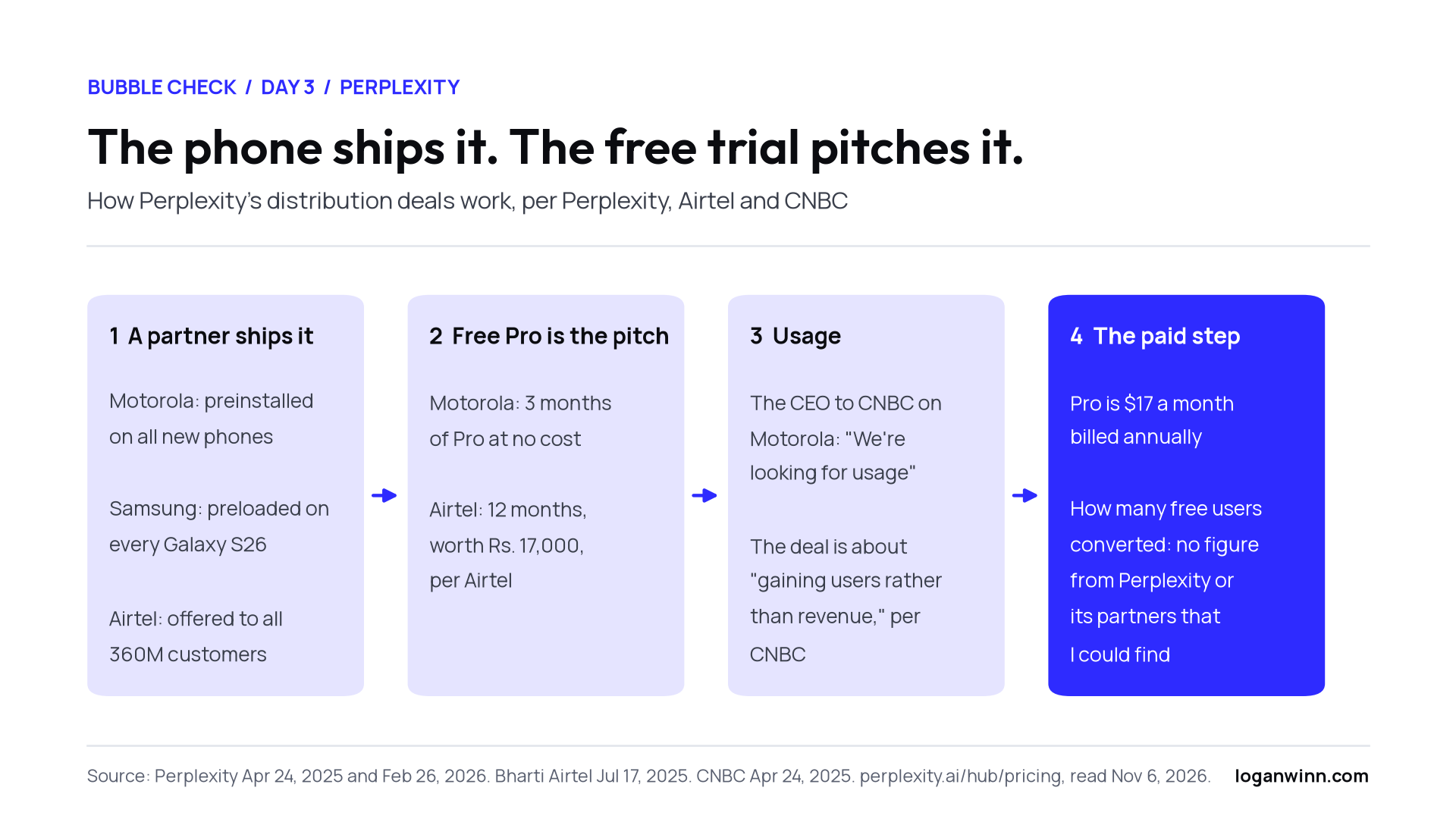
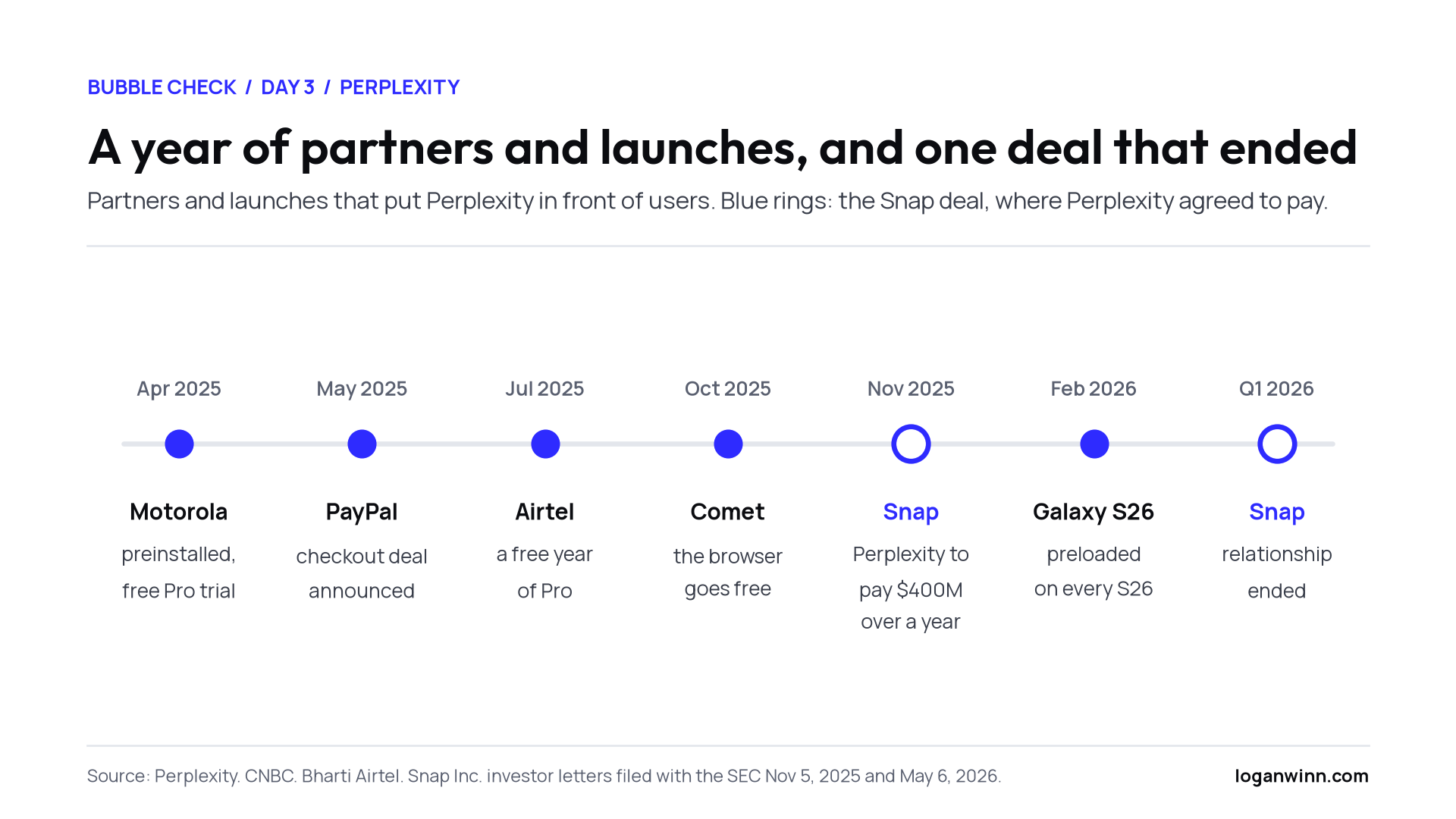
In April 2025 Perplexity announced that its app would come preinstalled on all new Motorola devices, and that new Motorola phone owners would get 3 months of Pro at no cost. It's a distribution partnership, "about Perplexity gaining users rather than revenue," CNBC reported after interviewing the CEO, and he said, "We're not making money off their sales or anything like that." Then: "We're looking for usage."
In July 2025 Bharti Airtel announced a free 12-month Pro subscription for all 360 million of its customers across mobile, Wi-Fi and DTH, a subscription Airtel valued at Rs. 17,000.
In February 2026 Perplexity said its app comes preloaded on every Galaxy S26 and powers search and reasoning for both its own assistant and Samsung's Bixby, making it, in Perplexity's words, "the first non-Google company to have OS-level access in a Samsung phone." In March, Perplexity said its APIs power Browsing Assist in Samsung Browser, "reaching more than 1 billion Samsung devices." By May, CNBC reported that Perplexity counts 92% of Fortune 500 companies as users.
Free, all the way down
Comet, Perplexity's browser, launched in July 2025 for Max subscribers at $200 a month and went free worldwide in October, per CNBC. In May 2025 Perplexity announced a PayPal deal so U.S. users could soon finish purchases in the chat with PayPal or Venmo, per CNBC.
When Perplexity agreed to pay
Per Snap's Q3 2025 investor letter, Perplexity agreed to pay Snap $400 million over one year, in cash and equity, as Snap achieved a global rollout. By February, Snap's Q4 letter left Perplexity revenue out of its Q1 guidance because the two had "yet to mutually agree on a path to a broader roll out." In May, Snap's Q1 2026 letter said they "amicably ended the relationship in Q1."
Perplexity's revenue, and three explanations for it
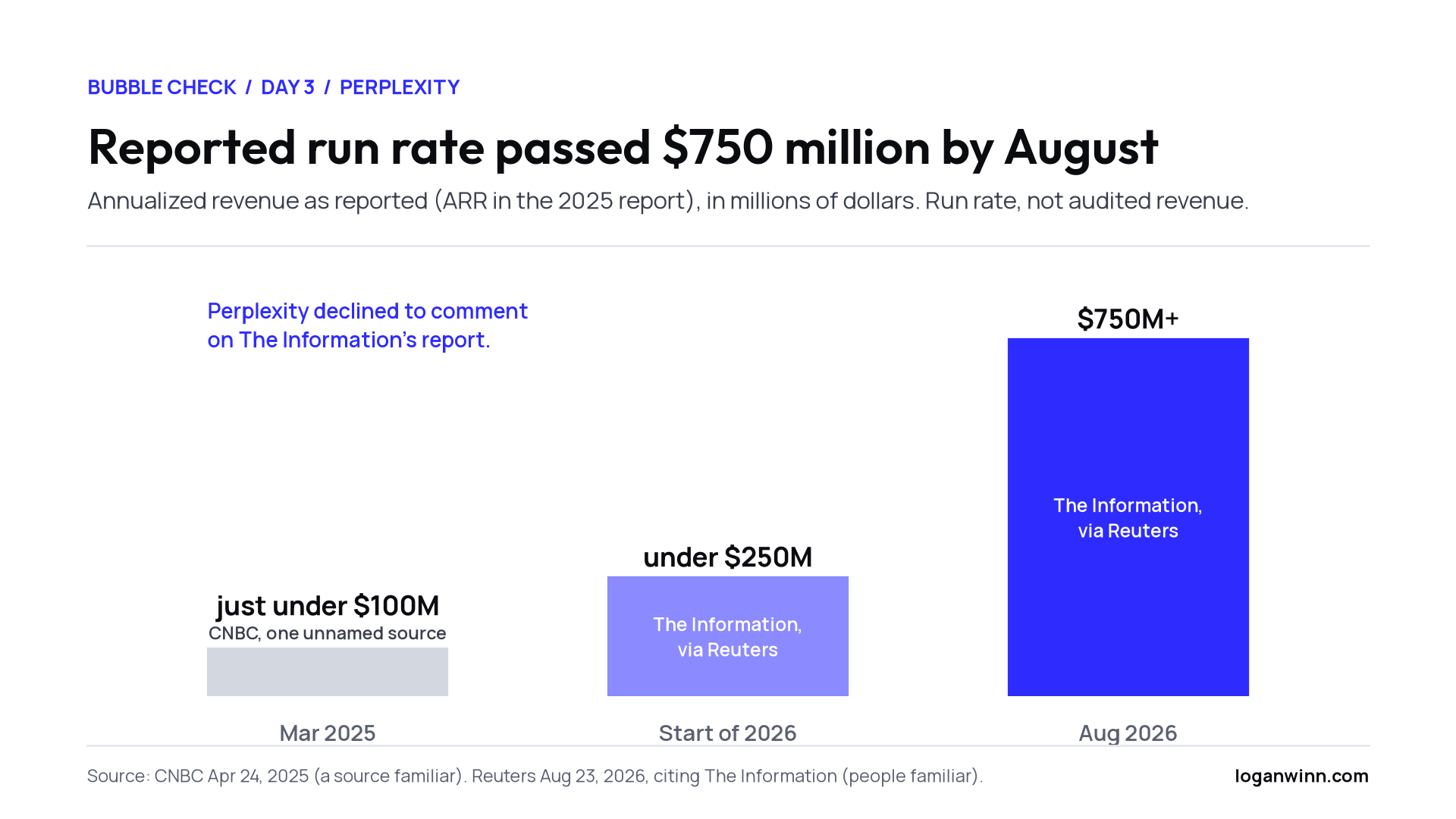
Perplexity's annualized revenue rose to more than $750 million in August from less than $250 million at the start of the year, according to The Information, as reported by Reuters. Perplexity declined to comment. That's a run rate, not audited revenue. In March 2025 it had just under $100 million in annual recurring revenue, a source told CNBC.
The CEO told CNBC in June that annualized revenue had tripled since the start of the year "thanks to model advances that have been made by Anthropic." The Information, per Reuters, credits Perplexity Computer, a cloud agent for professionals, with part of the growth. The FT's April headline has monthly revenue up 50% "in pivot from search to AI agents." I'm not going to pick one.
Per the same Reuters story, Nvidia was in talks to invest at a valuation above $30 billion, per The Information, against a last finalized valuation of $20 billion in September 2025.
What I think they get wrong
The distribution story has no scoreboard. I couldn't find a figure from Perplexity, Motorola, Samsung or Airtel on how many people opened the app, or how many free Pro users became paying ones. With ads gone, usage turns into money from a consumer only when they subscribe. The one partnership where the companies made an outcome public is Snap, and it ended. For Airtel, the app tracker Sensor Tower told TechCrunch that Perplexity's monthly users in India peaked near 22 million in October and were near 14 million in July 2026. It can't separate users who chose to pay from ones who missed the cancel date. The Airtel offer went live in July 2025 with a 12-month term, so a renewal number could exist by now. Publishing one cohort's conversion, even a range, would do more for a $30 billion conversation than another device count.
In the AE seat
Carrier and OEM deals buy users, not revenue. The BD seat's job is the conversion step after the preinstall. I built bank partnerships at Envestnet Yodlee, and a signed partner was where the work started. My first 90 days carrying this book:
Days 1 to 30: get the partner data. For each carrier and phone maker, who opened the app in week one, who used Pro during the trial, and when each free period runs out. Motorola's trial is 3 months and Airtel's is 12, so they're two different calendars.
Days 31 to 60: build the upgrade pitch for the day the free period ends, and agree with each partner where it reaches the customer. Then sort the free users by work domain. With 92% of the Fortune 500 counted as users, those accounts are warm leads for $34 Enterprise Pro seats.
Days 61 to 90: put a conversion number in front of every partner and make paid users, not installs, the measure for the next renewal of the deal. A device count is what the partner gives Perplexity. The paid number is what Perplexity needs back.
Is Perplexity a bubble?
The revenue part looks real to me. A reported run rate above $750 million in August, up from just under $100 million in March 2025, is money coming in, though these are reported run rates, not audited figures. The valuation talk is the stretch: above $30 billion against $750 million is about 40 times the reported run rate, by my math. Perplexity's own numbers show the reach. They don't show how much of that reach pays, and a price like that assumes a lot of it does.
This is day 3 of 30. Yesterday: Day 2, OpenAI. Tomorrow: Nvidia. Every post in the series is at loganwinn.com/blog.
Sources
- CNBC, "Perplexity AI enters the smartphone market with Motorola partnership", 2025-04-24.
- Perplexity, announcement of its global partnership with Motorola, 2025-04-24.
- CNBC, "Perplexity partners with PayPal for in-chat shopping as AI race heats up", 2025-05-14.
- Bharti Airtel, press release on free Perplexity Pro for all 360 million Airtel customers, 2025-07-17.
- CNBC, "Perplexity AI rolls out Comet browser for free worldwide", 2025-10-02.
- eMarketer, "Perplexity steps away from its advertising goals without measurable monetization results", 2025-10-10.
- Snap Inc., Q3 2025 investor letter (SEC 8-K exhibit), 2025-11-05.
- Snap Inc., Q4 2025 investor letter (SEC 8-K exhibit), 2026-02-04.
- Financial Times, "Perplexity drops advertising as it warns it will hurt trust in AI", 2026-02-18.
- eMarketer, "Perplexity's retreat from ads marks a split on AI monetization models", 2026-02-18.
- TechCrunch, "Perplexity's free AI offer left it with millions more users in India", 2026-08-18.
- Perplexity, "Perplexity APIs deliver powerful AI to the world's largest Android device maker", 2026-02-26.
- Perplexity, post on its APIs powering Browsing Assist on Samsung devices, 2026-03-26.
- Financial Times, "Perplexity monthly revenue jumps 50% in pivot from search to AI agents", 2026-04-08.
- Snap Inc., Q1 2026 investor letter (SEC 8-K exhibit), 2026-05-06.
- CNBC, Disruptor 50 profile of Perplexity, 2026-05-19.
- CNBC, "Perplexity CEO tells CNBC one metric will determine who wins the AI race", 2026-06-03.
- Reuters, "Nvidia discusses Perplexity investment at $30 billion-plus valuation, The Information reports", 2026-08-23 (wire text also at The Star).
- Perplexity, "Pricing" and its enterprise tab, undated pages, read 2026-11-06.
Social image: Perplexity's CEO onstage at TechCrunch Disrupt 2024, photo by Kimberly White/Getty Images for TechCrunch, via TechCrunch on Wikimedia Commons, CC BY 2.0, cropped.