OpenAI's run rate hit $40 billion in August. The product it most wants to sell has no public price.
Day 2 of 30. I'm going through the AI companies one a day, from a seller's seat, to work out whether the money is real.
Today's claim: OpenAI's sales team gets the first meeting for free, because the buyer's employees already use ChatGPT. The deal it most wants to close, the Frontier agent platform, is the one with no price you can look up.
The funnel behind OpenAI's revenue
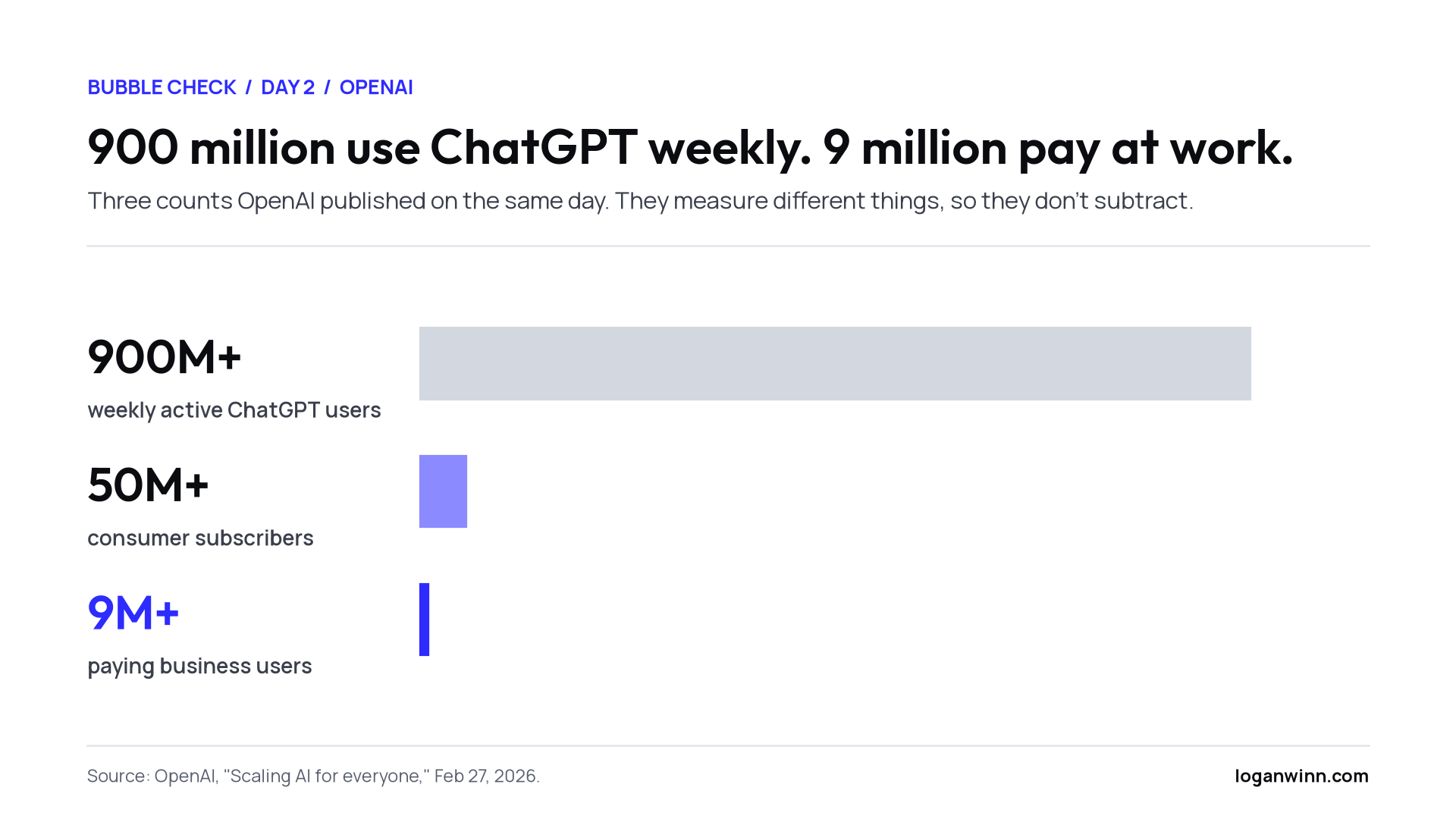
ChatGPT has more than 900 million weekly active users and more than 50 million consumer subscribers, and more than 9 million paying business users rely on it for work, per OpenAI's "Scaling AI for everyone" post from February 27, 2026. In November 2025, OpenAI said it had more than 1 million business customers, a count that includes companies paying for the API as well as ChatGPT for Work, plus more than 7 million ChatGPT for Work seats, with Enterprise seats up 9x year over year.
OpenAI is plain about how one feeds the other. "Our enterprise momentum is fueled in part by consumer adoption," the November post says, and with more than 800 million weekly users already familiar with ChatGPT, "pilots are shorter and rollouts face less friction." In April, its enterprise strategy post said 900 million weekly users "means employees already know how to work with it." That's the pitch. The training is done before the contract is signed.
Where the ChatGPT Business price list stops
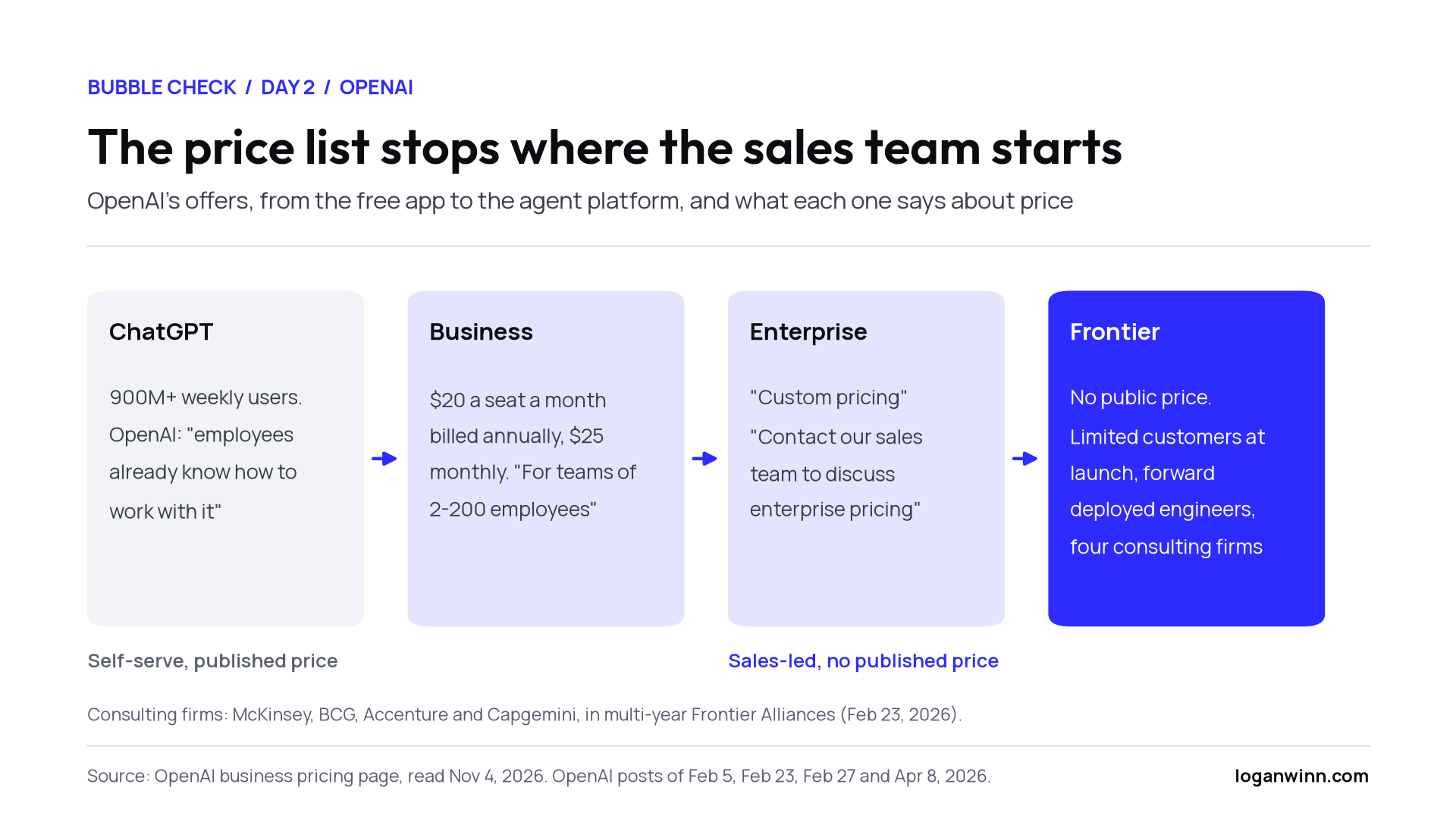
ChatGPT Business is $20 a seat a month billed annually, or $25 billed monthly, and a Premium seat is $100 a month annually or $125 monthly, per OpenAI's business pricing page, read November 4. The plan is for teams of 2 to 200 employees. Above that, Enterprise is "Custom pricing," and the page tells you to contact the sales team.
The $20 is recent. In April OpenAI cut the annual Business price from $25 to $20 a seat and let Business and Enterprise teams add Codex-only seats on pay-as-you-go pricing, per its Codex pricing post. An update on the same post, dated June 24, says new pay-as-you-go seats are no longer available on Business plans. Existing ones weren't affected.
OpenAI Frontier, the deal with no price tag
OpenAI launched Frontier on February 5, 2026, as a platform that helps enterprises "build, deploy, and manage AI agents that can do real work." It went to "a limited set of customers," and the way in was "reach out to your OpenAI team." OpenAI pairs its Forward Deployed Engineers with the customer's teams, and a small group of AI-native builders (Abridge, Clay, Ambience, Decagon, Harvey and Sierra) signed on as Frontier Partners. At a press briefing, OpenAI's then revenue chief declined to disclose pricing, per The Verge, and OpenAI declined to comment on price to TechCrunch. When I read the Frontier product page on November 4, it still showed no price, only the Enterprise Frontier Program that pairs forward deployed engineers with your team.
Frontier's named customers depend on who you read: at launch TechCrunch named HP, Oracle, State Farm and Uber and The Verge named Intuit, State Farm, Thermo Fisher and Uber, and in April OpenAI named Oracle, State Farm and Uber. State Farm and Uber are on every list.
The consultants are the channel
On February 23 OpenAI announced its Frontier Alliances, multi-year partnerships with BCG, McKinsey, Accenture and Capgemini "to help deploy AI coworkers across the enterprise." Each partner is investing in dedicated practice groups and building teams that will be certified on OpenAI technology, working alongside OpenAI's Forward Deployed Engineering team. TechCrunch described the partnerships as a way "to sell its enterprise products," and noted that Anthropic had signed consulting deals with Deloitte and Accenture in the months before. Neither source gives the financial terms.
One of the four was already a big customer. Accenture had "already begun equipping tens of thousands of its professionals with ChatGPT Enterprise," per OpenAI's post.
OpenAI's enterprise revenue passed consumer
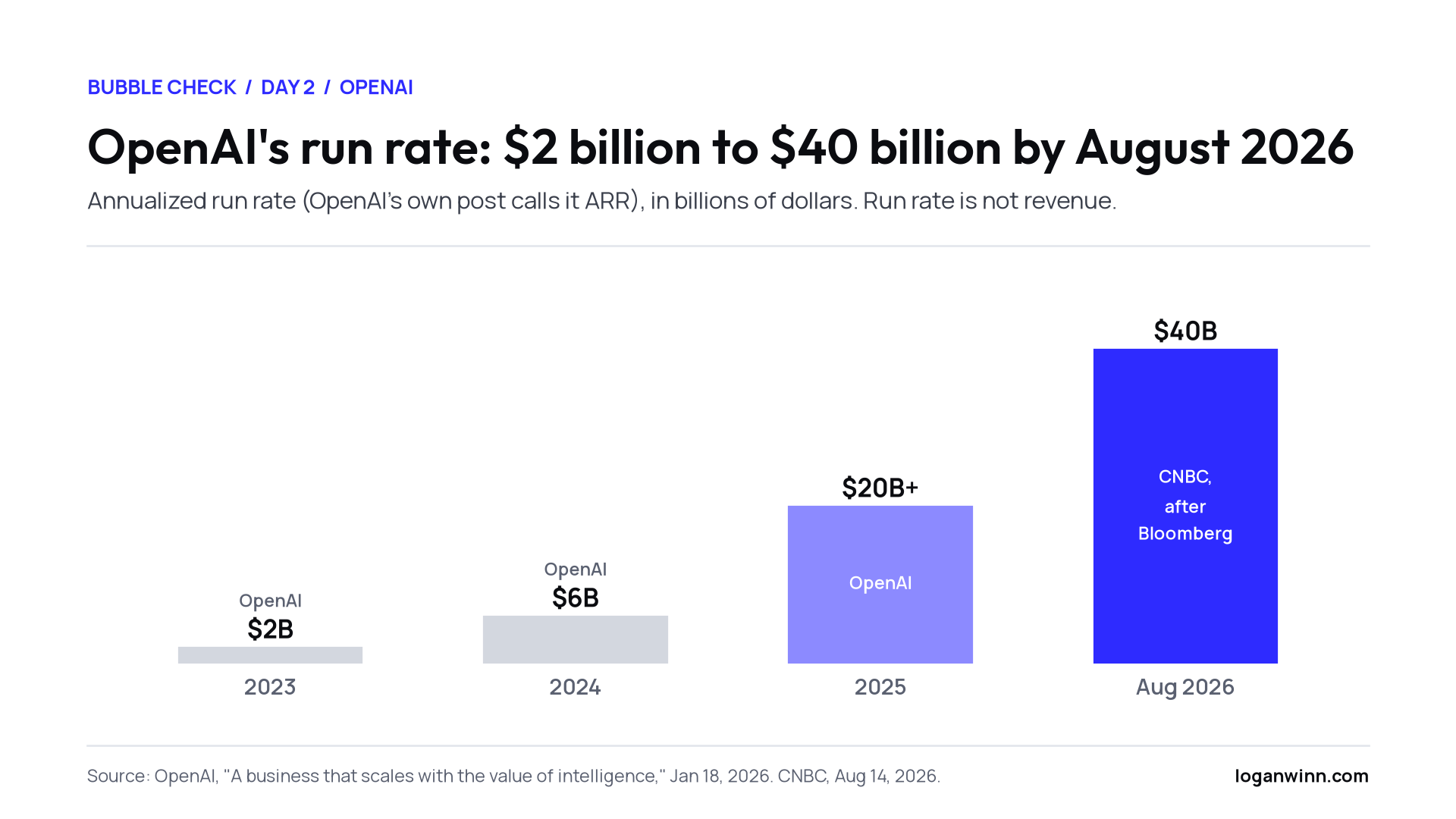
OpenAI's ARR, its word for run rate, was $2 billion in 2023, $6 billion in 2024 and more than $20 billion in 2025, per a January post from its CFO. In April, OpenAI said enterprise was more than 40% of revenue and "on track to reach parity with consumer by the end of 2026."
It got there early, per CNBC in August. The CFO told investors "We entered the year at 60-40, but enterprise has accelerated much faster than expected and those lines have now crossed," according to one person in the room. The same story says CNBC confirmed a $40 billion annualized run rate after Bloomberg first reported it, that run rate rose 20% month over month in July while business customers grew 32%, per slides CNBC viewed, and that advertising is approaching a $1 billion run rate, per the attendee. The April forecast and the August crossover read as a sequence, not a conflict, but the crossover rests on one unnamed attendee, and I found no OpenAI statement that says it.
What I think they get wrong
The soft spot is in the same CNBC story. Per the attendee, the CFO told investors that "enterprise customers have moved from tokenmaxxing to focusing on cost per unit of intelligence." A buyer who measures cost per unit wants a number to put in a spreadsheet next to the other vendors. OpenAI publishes a seat price for teams of up to 200 and then stops, and the product it calls "the underlying intelligence layer governing all of a company's agents" has had no public price since February. Respectfully, a famous brand gets the meeting. It doesn't win a cost comparison by itself. If buyers are shopping on unit cost, I'd publish a starting price for Frontier, even just a floor, so the buyer can run the math before the consultants show up.
In the AE seat
Carrying this book means you start with brand pull a rep anywhere else has to build, and a buyer who thinks they already know the product. Discovery has to dislodge that. My first 90 days:
Days 1 to 30: list the accounts where people already pay for ChatGPT at work, starting with Business workspaces near the 200-employee ceiling, since growing past 200 puts them on custom pricing and a sales call anyway. Skip the demo. They think they've seen it.
Days 31 to 60: run discovery on one question, what do your people still do by hand? Each answer is a workflow, and each workflow is a Frontier case with a cost attached. When I was an enterprise BDR at Salesforce, my whole job was getting the first meeting. Here the brand books it, and the work is making the second meeting about the customer's process instead of the chatbot they use at home.
Days 61 to 90: bring in the Forward Deployed Engineer and, where the account already works with McKinsey, BCG, Accenture or Capgemini, that firm's OpenAI practice. Price the agent case as cost per finished task against what the manual version costs today, because cost per unit is the comparison buyers are now making, per CNBC.
Is OpenAI a bubble?
Not this part, to me. A run rate CNBC confirmed at $40 billion in August and about $50 billion at the end of September, per CNBC in October, is money coming in, and OpenAI's own figures show more than 9 million paying business users and an enterprise share that was already above 40% in April. Run rate isn't revenue, though, and the crossover past consumer rests on one person in the room. The risk is in the CFO's own line: buyers are shopping on cost per unit now, and a famous brand doesn't win that alone. OpenAI's numbers say the demand is real. Whether the price holds when the buyer starts comparing is the open question.
This is day 2 of 30. Yesterday: Day 1, Anthropic. Next: Perplexity. Every post in the series is at loganwinn.com/blog.
Sources
- OpenAI, "1 million business customers: the fastest-growing business platform in history", 2025-11-05.
- OpenAI, "A business that scales with the value of intelligence", 2026-01-18.
- OpenAI, "Introducing OpenAI Frontier", 2026-02-05.
- The Verge, "OpenAI Frontier is a single platform to control your AI agents", 2026-02-05.
- TechCrunch, "OpenAI launches a way for enterprises to build and manage AI agents", 2026-02-05.
- OpenAI, "OpenAI announces Frontier Alliance Partners", 2026-02-23.
- TechCrunch, "OpenAI calls in the consultants for its enterprise push", 2026-02-23.
- OpenAI, "Scaling AI for everyone", 2026-02-27.
- OpenAI, "Codex now offers pay-as-you-go pricing for teams", 2026-04-02, updated 2026-06-24.
- OpenAI, "The next phase of enterprise AI", 2026-04-08.
- CNBC, report on OpenAI's CFO telling investors that enterprise revenue is now bigger than consumer, 2026-08-14.
- CNBC, report that OpenAI told investors it hit roughly $50 billion in annualized revenue at the end of September, 2026-10-08.
- OpenAI, "Business Pricing", undated page, read 2026-11-04.
- OpenAI, "OpenAI Frontier", undated product page, read 2026-11-04.
Social image: OpenAI onstage at TechCrunch Disrupt San Francisco 2019, photo by TechCrunch, CC BY 2.0, cropped.