Anthropic's first half went from $1.2 billion to $16.3 billion. Developers sold it, not reps.
Day 1 of 30. I'm going through the AI companies one a day, from a seller's seat, to work out whether the money is real. Anthropic goes first because it filed its S-1 on October 26.
Today's claim: much of Anthropic's growth came from developers, not a big sales team, and the filing says so in its own risk factors.
What the S-1 says about Anthropic's revenue
Revenue was $16.3 billion for the six months ended June 30, 2026, against $1.2 billion for the same six months of 2025, per Anthropic's S-1. Quarterly revenue went from $376 million in Q1 2025 to $11.6 billion in Q2 2026. That quarter was up 1,368% on the year before, and operating margin went from negative 152% to positive 8%.
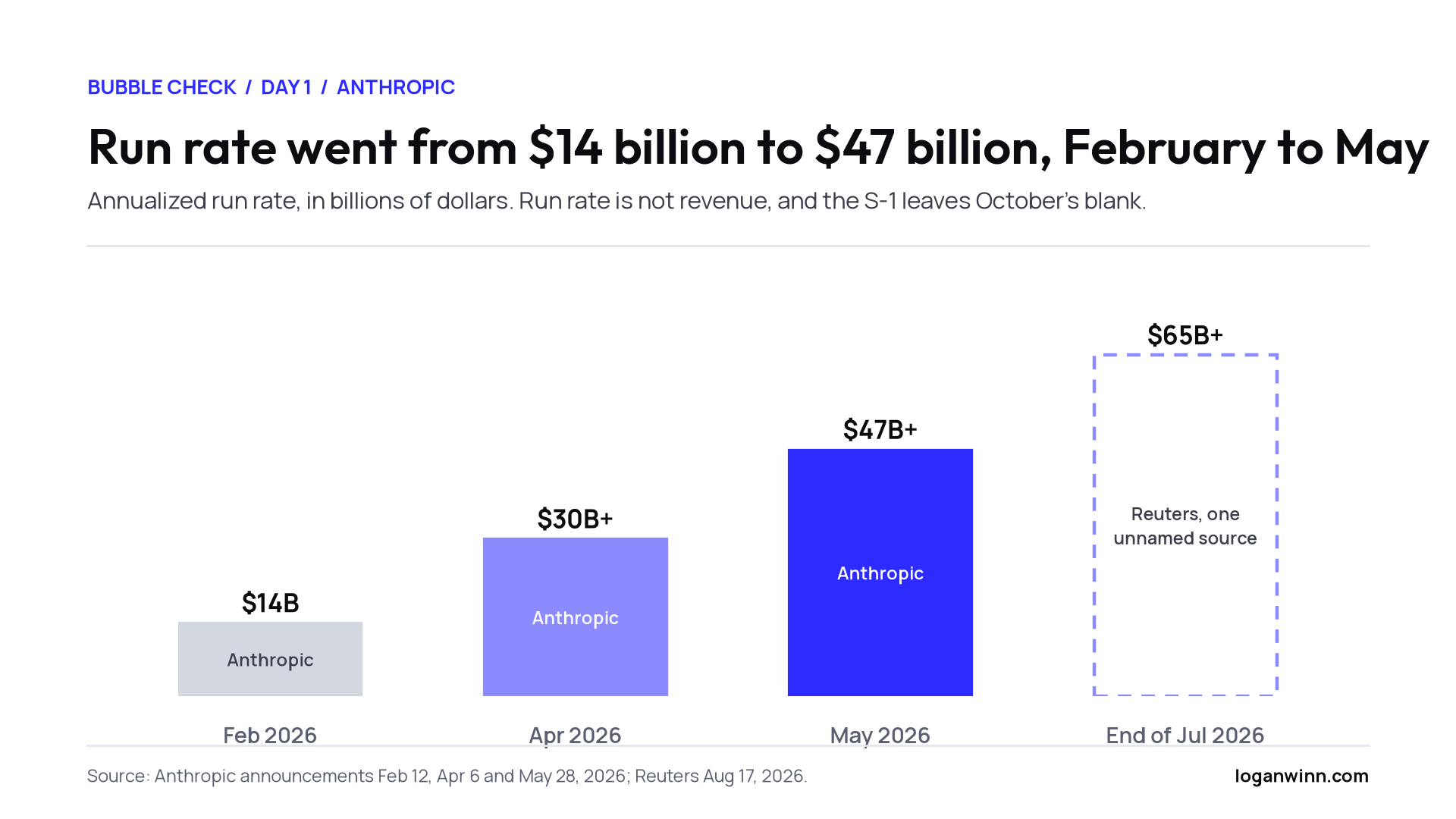
Run rate was $14 billion in February, per the Series G announcement, passed $30 billion in April, per the Google and Broadcom compute announcement, and crossed $47 billion in May, per the Series H announcement. The $65 billion figure for the end of July comes from Reuters, citing one unnamed source. Anthropic has not published it, and the S-1's run-rate line as of October 31 is blank. The filing says run rate "is not a substitute for revenue" and "is not a forecast of future revenue," and it expects the growth rate to decline over time.
How Anthropic makes money, and who pays
Two cuts, and they get mixed up. By pricing model, 80% of first-half revenue ($13.1 billion) was consumption-based and 20% ($3.2 billion) was subscriptions, per the S-1. That is metered usage versus subscription plans, not an enterprise-versus-consumer split, and the filing doesn't give one. The closest thing is Reuters from October 2025, which reported that more than 300,000 business and enterprise customers made up about 80% of revenue. Same percentage, different question.
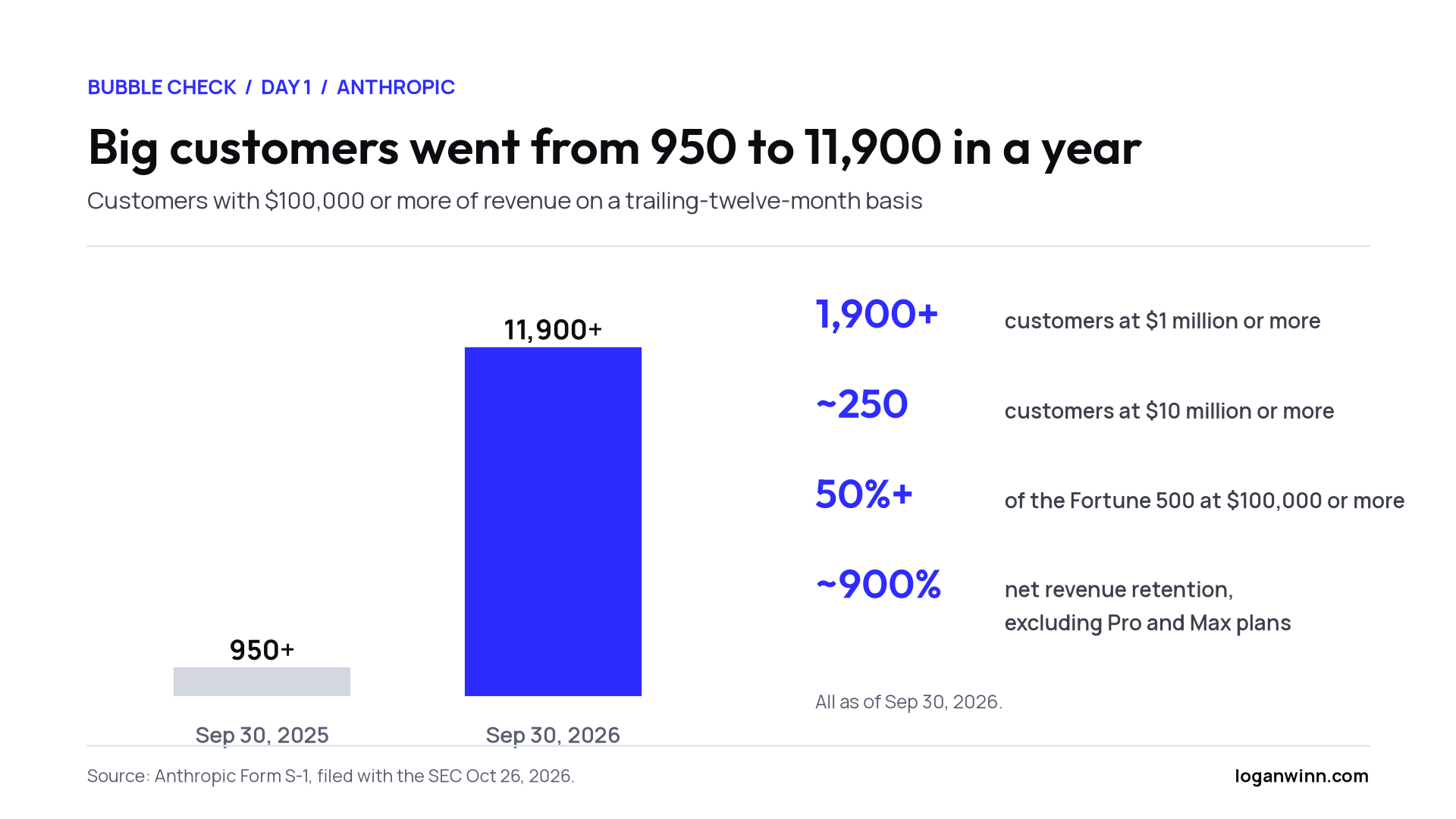
Customers spending $100,000 or more on a trailing-twelve-month basis went from more than 950 to more than 11,900 between September 2025 and September 2026, per the S-1. More than 1,900 spend $1 million or more, about 250 spend $10 million or more, and roughly 40 million customers spend under $100,000 each. Over half the Fortune 500 is in the $100,000 tier, and Anthropic's revenue from those companies is on average less than 0.1% of their total expenses. One count gets quoted two ways: Anthropic's April compute post said more than 1,000 customers spent over $1 million on an annualized basis, while the S-1's 1,900 is on a trailing-twelve-month basis.
Net revenue retention was approximately 900% as of September 30, 2026, per the S-1. The definition excludes Pro and Max subscribers, so that is the enterprise and API base: the customers Anthropic had a year ago are spending roughly nine times as much now. Concentration is also coming down. The top five customers were about 25% of revenue for the nine months to September 30, no single customer was over 10%, and 79% of third-quarter revenue came from outside the top five, up from 64% in the first quarter.
Claude Code is the wedge
Claude Code's run rate was over $2.5 billion in February, more than double where it started the year, per the Series G post, which also said enterprise use was over half of its revenue. The S-1 gives no Claude Code revenue line, so February's number is the latest from a primary.
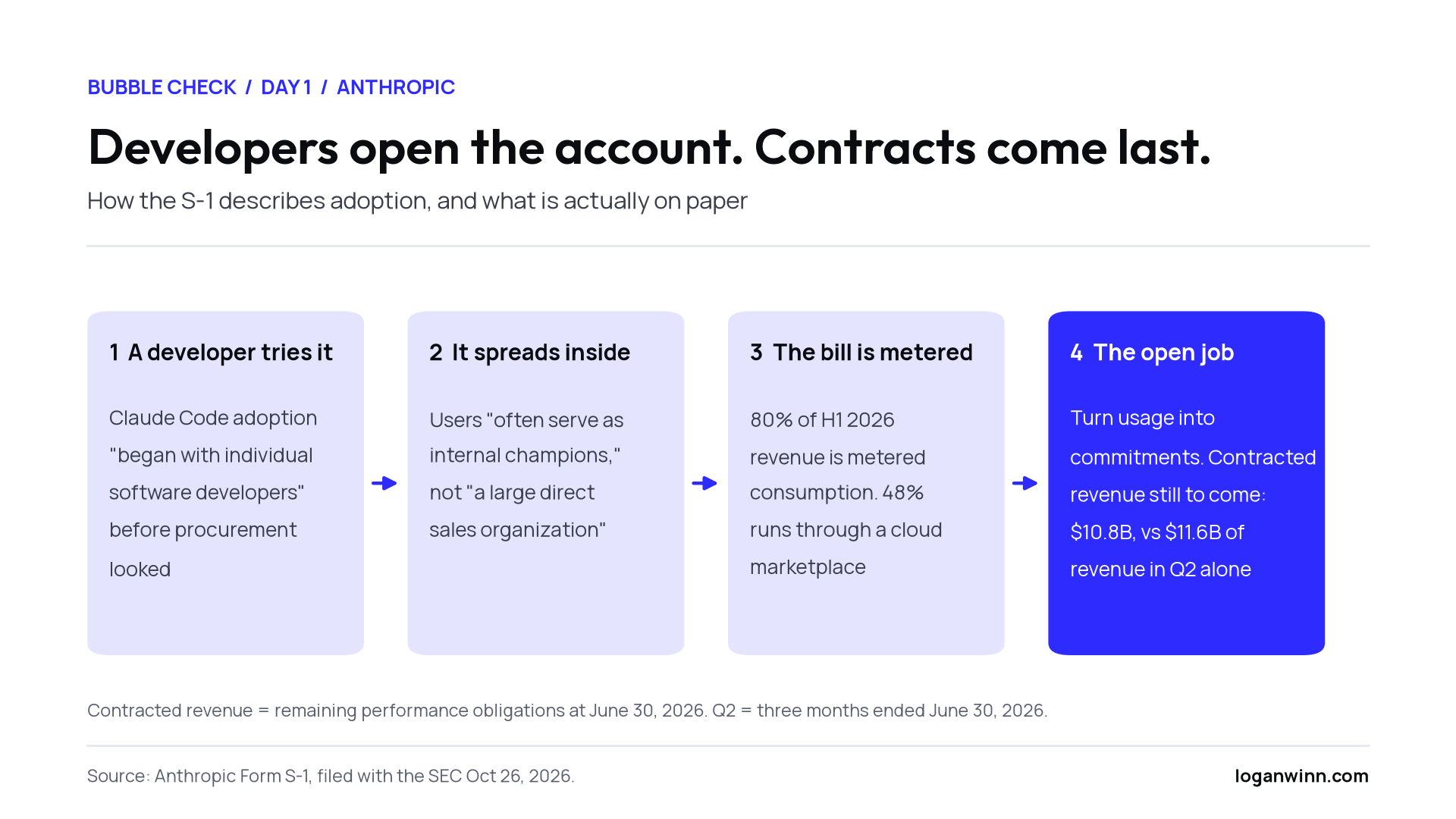
What the S-1 does say is how it got in. Claude Code adoption "began with individual software developers who noticed the potential of autonomous coding agents before enterprise procurement teams had considered the category." Much of the diffusion of Claude has been "organic," driven by individual users who "often serve as internal champions," "rather than by a large direct sales organization." Claude Enterprise users without Claude Code spent under $75 a month on average in the third quarter. The top 5% of users with it spent about 20 times that.
The filing puts this motion under risk factors. If competitors "capture the individual users from whom our enterprise adoption often originates," the pipeline "could be reduced in ways that a direct sales organization of our current scale may not be able to offset." That's a company telling you its sales org may not be able to replace its developers.
Nearly half the invoice runs through someone else's marketplace
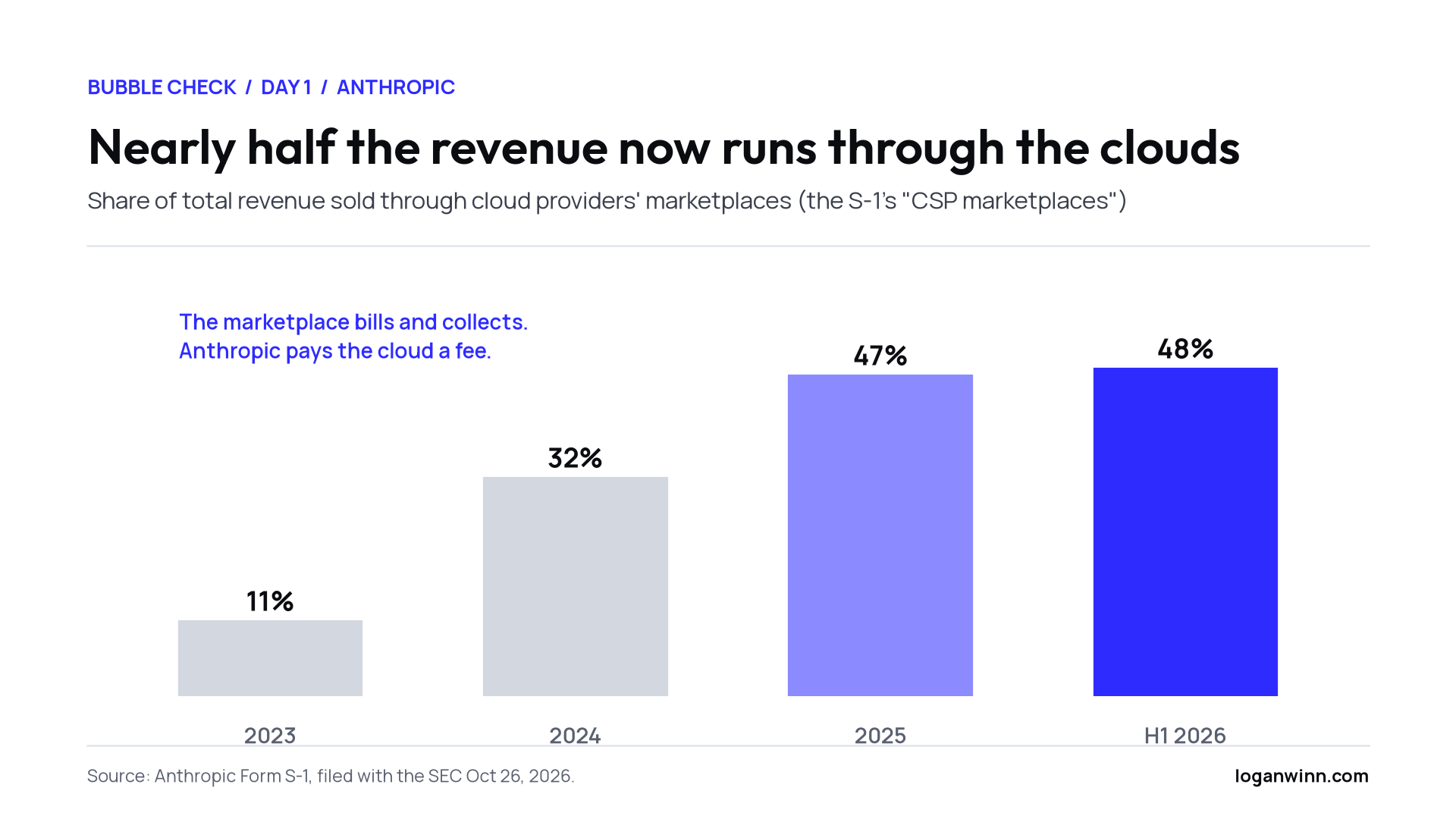
Revenue through cloud providers' marketplaces was 11% of the total in 2023, 32% in 2024, 47% in 2025 and 48% in the first half of 2026, per the S-1. The marketplaces bill and collect, Anthropic keeps a direct contract with the customer and pays the cloud provider a fee, and the cost shows up in the sales line: sales, marketing and partnerships expense went from $120 million in the first half of 2025 to $3.17 billion in the first half of 2026, 10% of revenue to 19%, driven mainly by $2.7 billion more in fees paid to channel partners. The filing also lists "reliance on the CSPs' procurement, security, and billing workflows" as a risk.
The compute bill, in one paragraph
Per the S-1, Anthropic committed to spend at least $44.9 billion with Microsoft between November 2026 and May 2033, at least about $114.5 billion with Google between April 2026 and July 2033, and at least $110.0 billion with Amazon between May 2026 and April 2036, each "regardless of actual usage." Another $125 billion to $150 billion of estimated TPU payments for 2028 to 2031 sits outside the commitments table. The revenue is metered and can go down. These minimums cannot.
What I think they get wrong
The filing's own line is that "many of our top customers are not subject to long-term contracts with us or have contracts with near-term expiration dates and are able to reduce or in some cases cease spending at any time and for any reason." Put that next to 900% net revenue retention and compute minimums that run to 2033 and 2036. Anthropic is running the best usage-led motion I've seen in software, and only part of it is on paper. A growing number of enterprise customers sign non-cancelable annual or multi-year contracts with minimum spend, per the S-1, but remaining performance obligations, the contracted revenue still to come, were $10.8 billion at June 30. That's less than the $11.6 billion of revenue in the second quarter alone. Most of the revenue is metered consumption while the costs are fixed for years. I'd call that a sales problem, and the risk factor about a sales org "of our current scale" reads to me like the company knows it. Respectfully, the sales team already has the customers. Its job is to turn their usage into commitments.
In the AE seat
A developer-led book means the usage shows up before the rep calls. The job is expansion and procurement, not discovery. The first 90 days of carrying that book, as I'd run them:
Days 1 to 30: pull consumption by account and rank it by growth over the last two quarters and by how many engineers are on Claude Code. The accounts near the top with no enterprise agreement are the list.
Days 31 to 60: find the engineer who brought it in, because the filing says that person is often the internal champion, and work outward to whoever owns the cloud budget. With 48% of revenue already moving through the marketplaces, a lot of that paper will run through the cloud the customer already buys from.
Days 61 to 90: convert the top of the list to committed-spend agreements, with the spend they are already doing as the floor and a multi-year term. When I was an enterprise BDR at Salesforce, the hard part was getting the first meeting. Here the first dollar is already in, and the whole quarter is about the term.
Is Anthropic a bubble?
This part doesn't look like one to me. $16.3 billion of first-half revenue is reported under GAAP in a registration statement, the second quarter had a positive operating margin, and the customer base is widening rather than concentrating. What the same filing shows is that the revenue is metered, that many top customers can cut spending at any time, that growth is expected to slow, and that hundreds of billions in compute minimums are owed either way. Anthropic's own numbers say the demand is real today. Whether this turns into a bubble comes down to contract terms and compute.
This is day 1 of 30. Tomorrow: OpenAI. Every post in the series is at loganwinn.com/blog.
Sources
- Anthropic, PBC, "Form S-1 registration statement", SEC EDGAR, 2026-10-26.
- Anthropic, "Anthropic raises $30 billion in Series G funding at $380 billion post-money valuation", 2026-02-12.
- Anthropic, "Anthropic expands partnership with Google and Broadcom for multiple gigawatts of next-generation compute", 2026-04-06.
- Anthropic, "Anthropic raises $65B in Series H funding at $965B post-money valuation", 2026-05-28.
- Reuters, via The Star, "Anthropic revenue run rate tops $65 billion, source says", 2026-08-17.
- Reuters, via Yahoo Finance, "Exclusive-Anthropic aims to nearly triple annualized revenue in 2026, sources say", 2025-10-15.
Social image: Dario Amodei at TechCrunch Disrupt 2023, photo by TechCrunch, CC BY 2.0, cropped.