The cloud company growing 29% while everyone watches the hyperscalers. What DigitalOcean got right, and who should be building on it.
Originally published on LinkedIn.
I spent years in sales at Salesforce, ADP, and Envestnet Yodlee, selling to everyone from five-person shops to the largest banks in the country. Today I'm a partner in two JG Academy jiu-jitsu gyms and I run my own back office on a system of AI agents I built myself. That gives me two angles on the cloud market: the seller who watched companies buy infrastructure they never fully used, and the small operator who pays the bill every month.
From both seats, DigitalOcean is the most interesting company in cloud right now. Here is the story, with the numbers.
A 14-year-old company that is growing faster, not slower
DigitalOcean started in 2012 with one idea: a developer should be able to get a server in under a minute, understand the bill, and get back to work. Fourteen years later it serves more than 680,000 customers in 190 countries from 16 data centers across 13 regions, and the original idea still holds. A Droplet, their name for a virtual machine, starts at $4 a month. Billing went per-second in January 2026. Outbound bandwidth is included and pooled across your account.
That simplicity used to get DigitalOcean filed under "nice for side projects." The 2026 numbers end that conversation.
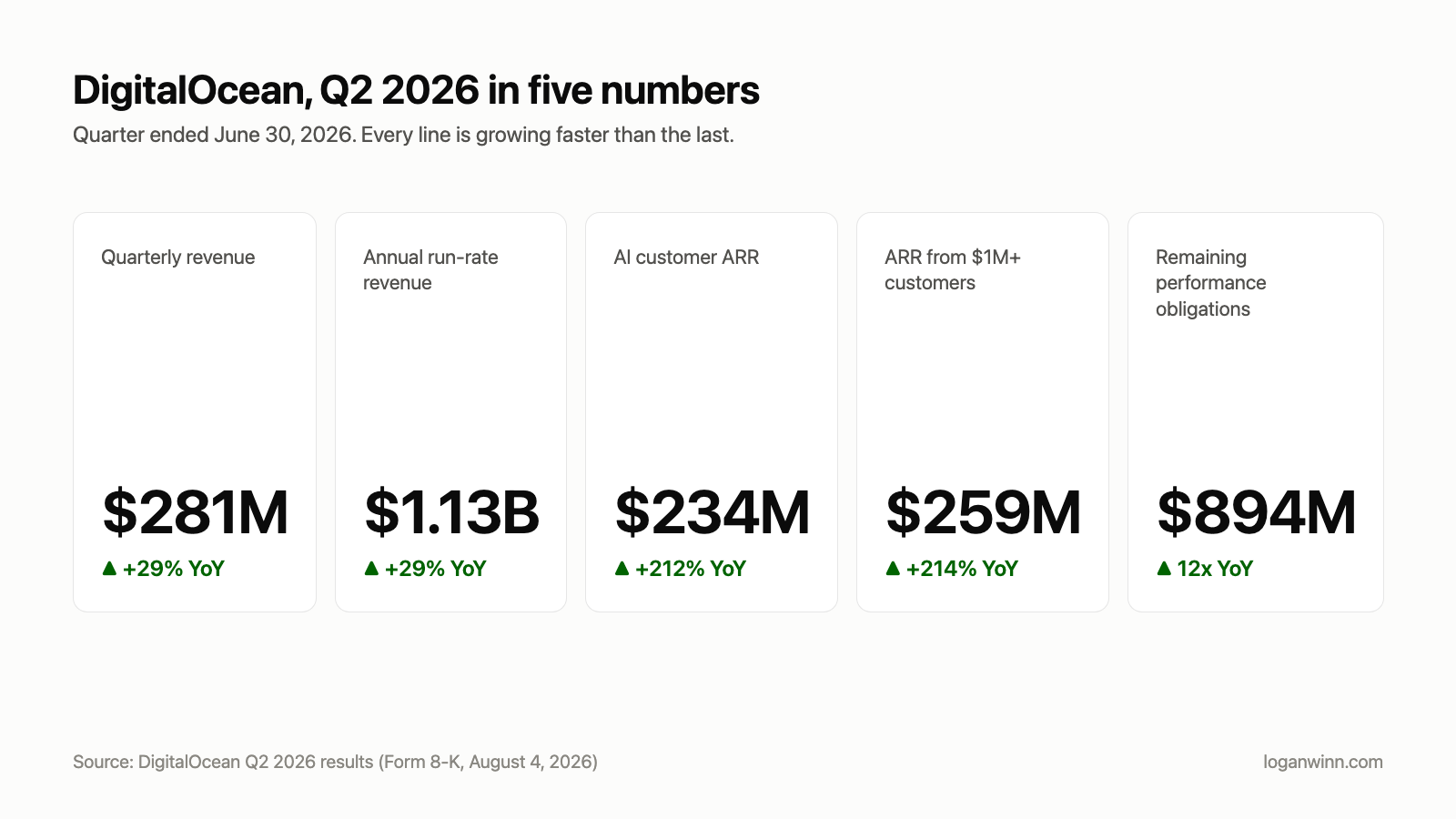
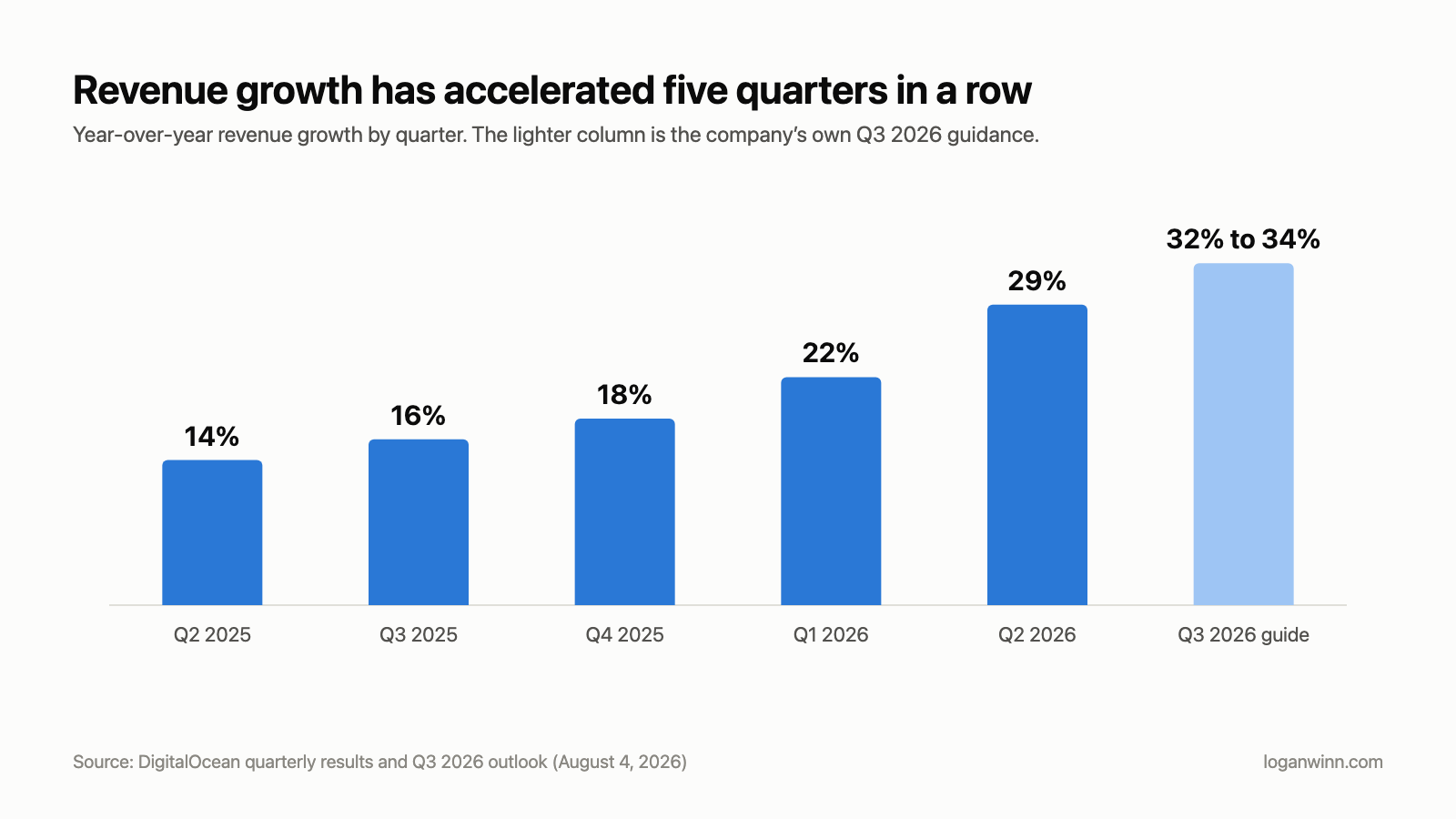
In the quarter ended June 30, revenue was $281 million, up 29% year over year, more than double the growth rate of a year earlier. Annual run-rate revenue crossed $1.1 billion. The company added a record $93 million of incremental ARR in a single quarter. Remaining performance obligations, the contracted revenue not yet recognized, went from $71 million to $894 million in twelve months. That is a 12x increase in signed commitments, and it happened at a 40% adjusted EBITDA margin with $767 million of cash on the balance sheet.
Management raised full-year guidance to $1.17 to $1.18 billion and said they expect growth to reach 35% or more by Q4 and exceed 50% in 2027. Companies this size do not usually accelerate. DigitalOcean is.
What changed: they built the AI-native cloud instead of bolting AI onto the old one
The acceleration has one source. AI customer ARR hit $234 million in Q2, up 212% from $75 million a year earlier. Revenue from customers spending $1 million or more a year grew 214%. DigitalOcean landed its first nine-figure annual commitments this year, and the weighted average contract life stretched from 1.6 years to more than three.
Here is the part I find most impressive as a seller. 85% of that AI revenue comes from inference and core cloud, not from renting bare-metal GPUs. In other words, customers are not just borrowing hardware. They are running production AI systems on the platform.
The products behind that:
- Inference Engine, launched in April 2026. You call an open-weight model like DeepSeek V3.2 through an API and pay per token, with no GPUs to manage. More than 6,000 customers used it in its first quarter, and early customers drove their token consumption up roughly 30x in 60 days.
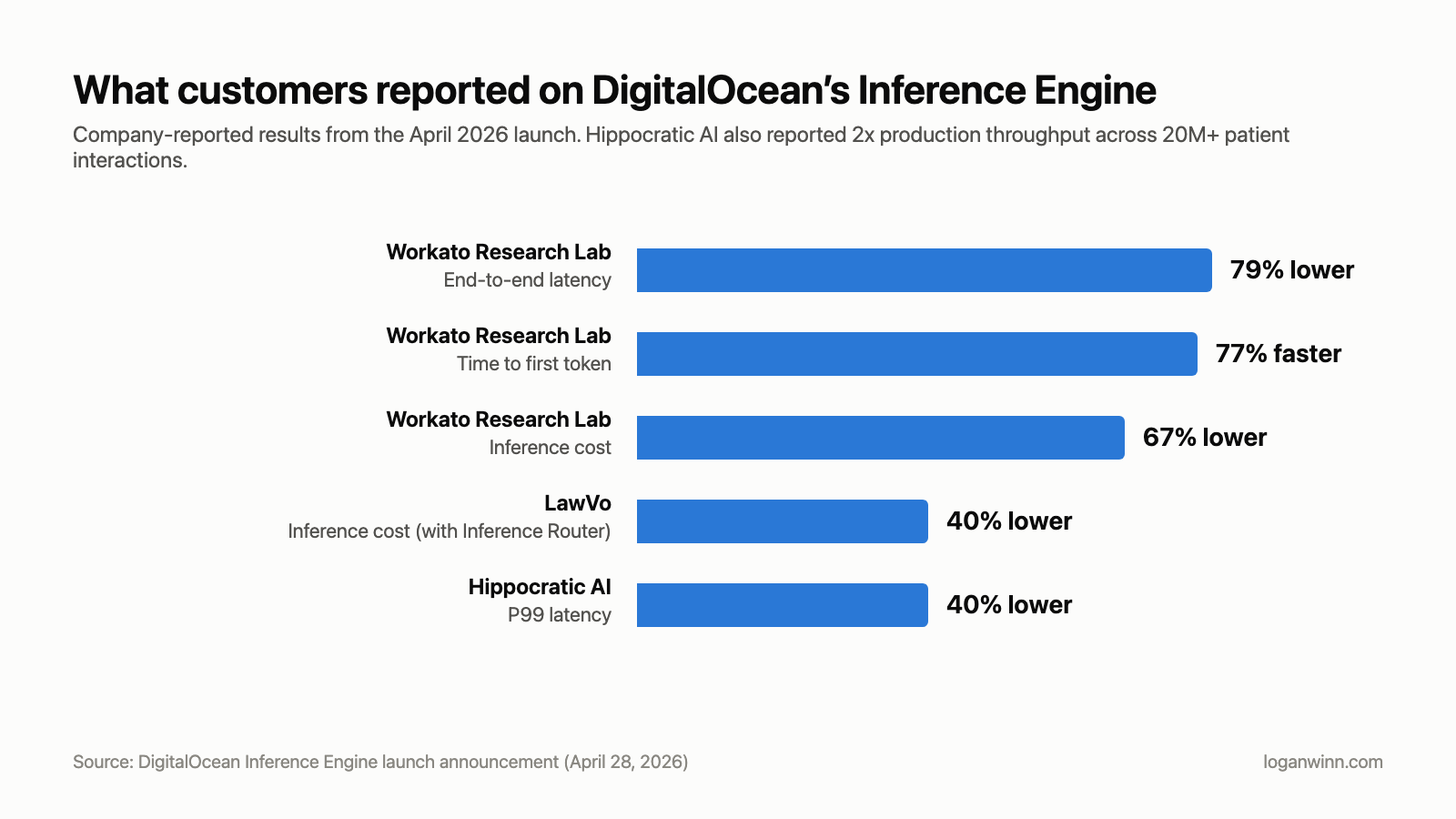
- Inference Router, launched the same day. It sends each request to the model that fits the cost and quality you need. Legal AI company LawVo reported inference costs more than 40% lower with accuracy, speed, and reliability held.
- GPU Droplets on NVIDIA Blackwell Ultra for teams that train, fine-tune, or host their own models. Hippocratic AI reported 2x production throughput and 40% lower P99 latency across more than 20 million patient interactions, and later scaled to 10 million patient calls at a 99.9% clinical safety score.
- Agent Droplets, launched October 1. One subscription that bundles everything an agent needs: a dedicated microVM sandbox that starts in about a second, memory, session storage, hosted open models, and access to more than 16,000 tools. $50 a month for Pro, $200 for Team.
DigitalOcean shipped more than 80 product releases between April and August. CEO Paddy Srinivasan put the philosophy in one line on the Q2 call: "Like traditional open source software, the model may be free, but making it useful and serving it well is the product."
Why builders choose DigitalOcean over the hyperscalers
I have watched enterprise buyers sign for platforms they then needed a team to operate. Srinivasan named that dynamic directly: "Assembling capabilities is not the same as building an integrated platform, and customers often bear that complexity." And on the field: "Hyperscalers optimize for frontier labs and large enterprises."
DigitalOcean optimizes for everyone else, and four things follow from that.
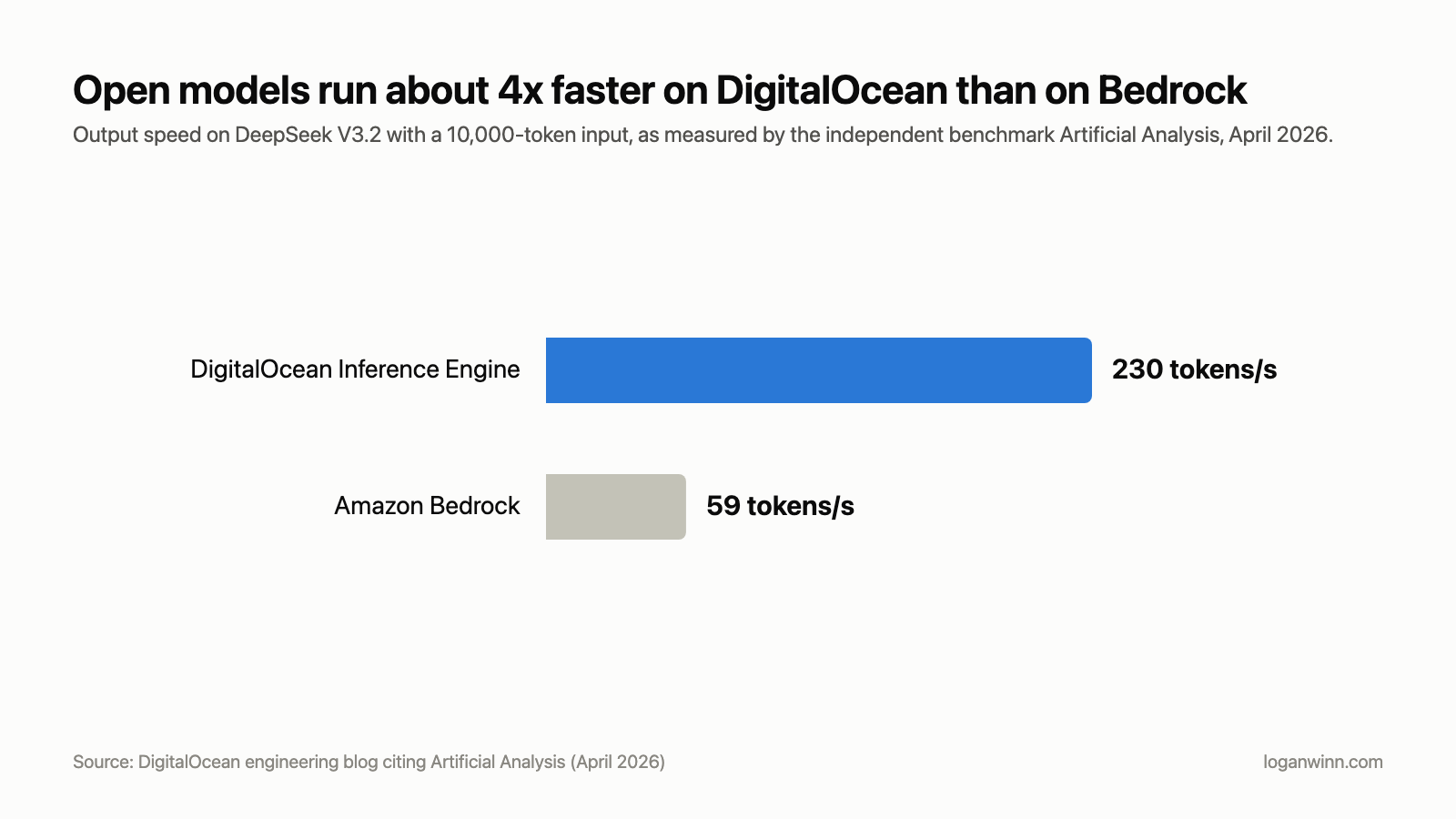
1. The bill is predictable. Per-second billing, bandwidth included, flat Droplet pricing, and agent plans priced as a monthly subscription. You can explain your cloud cost in one sentence. 2. Open models run faster. Artificial Analysis, an independent benchmark, measured DeepSeek V3.2 output at roughly 230 tokens per second on DigitalOcean against 59 on Amazon Bedrock with a 10,000-token input. DigitalOcean reports the number one output speed across every provider tested on DeepSeek V3.2 and Qwen 3.5 397B. 3. It is one platform, not a parts list. Compute, managed databases, object storage, Kubernetes, inference, routing, and agent runtime, designed to work together and sold on one bill. 4. It plugs into the tools builders already use. Vercel's AI gateway, OpenRouter, OpenCode, Daytona, and the big coding agents all route to DigitalOcean today.
Customers are voting with their spend. Net dollar retention reached 102% in Q2, a three-year high, which means the existing base is growing on its own before a single new logo is counted.
Who should be building on it
The ideal DigitalOcean customer has changed, and it is worth being specific.
AI-native startups running models in production. If your product calls an open-weight model thousands of times an hour, your inference line is your cost of goods sold. The Inference Engine and Router were built for exactly that bill. Workato's research lab, which processes more than a trillion automated workloads, reported 67% lower inference costs, 77% faster time to first token, and 79% lower end-to-end latency on the platform.
Developers and small teams who want to ship, not operate. App Platform takes your code and runs it. Managed databases handle backups, failover, and updates. Nobody on a five-person team should be the person who gets paged when Postgres goes down.
Digital-native businesses and agencies. This is the customer DigitalOcean has served since 2012: SaaS companies, e-commerce shops, agencies hosting dozens of client sites, anyone whose business runs on the web and whose team is small relative to the traffic. About two-thirds of DigitalOcean's revenue comes from customers spending $500 or more a month, which tells you these are real businesses, not weekend projects.
Solo operators running agents. This is me. My agents research accounts, draft outreach, watch an inbox, and stage a pipeline while I'm on the mats. Keeping one agent running used to mean a compute bill, a memory store, a storage bucket, a model bill, and a tool subscription, each on its own invoice. Agent Droplets collapses that into one number. That is the bill I'd have wanted on day one.
The sales story in one paragraph
Every DigitalOcean account starts the same way: a developer signs up, spins up a Droplet or calls the Inference Engine, and gets a result in minutes. Then the workload grows. The database gets managed. Storage and GPUs get added. A $4 experiment becomes a $500-a-month business, and a $500-a-month business becomes one of the $1 million-plus customers whose revenue grew 214% last quarter. That path, from self-serve to committed spend, is the whole model, and 2026 is the year it started compounding.
What I'd tell a founder this week
If you are building anything with AI in it and your team is smaller than your ambition, spend $5 and run your workload on DigitalOcean for a day. Compare the speed, read the bill, and count how many services you did not have to assemble yourself.
The hyperscalers will keep building for the frontier labs. DigitalOcean is building for the other 680,000 of us, and the growth rate says the other 680,000 noticed.
If you want the earlier piece on how I read the Salesforce and Anthropic partnership from a former BDR's seat, it is at loganwinn.com. Everything else I write lives at loganwinn.com/blog.
Cover photo: Carl Lender, CC BY 2.0, via Wikimedia Commons.